Dhanteras is one of the days many families in Delhi NCR choose for a registry, a booking or the keys to a new home. This year it falls on 6 November. Then comes the rush: painters, the carpenter for the modular kitchen, the shifting truck booked for an auspicious date after Diwali. Somewhere in that list, the termite check gets forgotten, and it's the one job that is far easier while the home is empty.
Termites (deemak, दीमक) in Delhi NCR are mostly subterranean: they live in the soil and climb into buildings through cracks, joints and conduits. In an empty flat, every door frame, wardrobe back and skirting line is visible. Once the sofa, beds and cartons are in, half of it is hidden for years.
Why check for termites before you shift, not after
There are four practical reasons:
- You can see everything. Wardrobe bases, the space under the kitchen sink, the back of the loft, behind where the bed will go.
- New furniture is at risk. Termites in a wall don't care whether the wood is old or new. A new modular kitchen or wardrobe fitted against an active wall is the next meal.
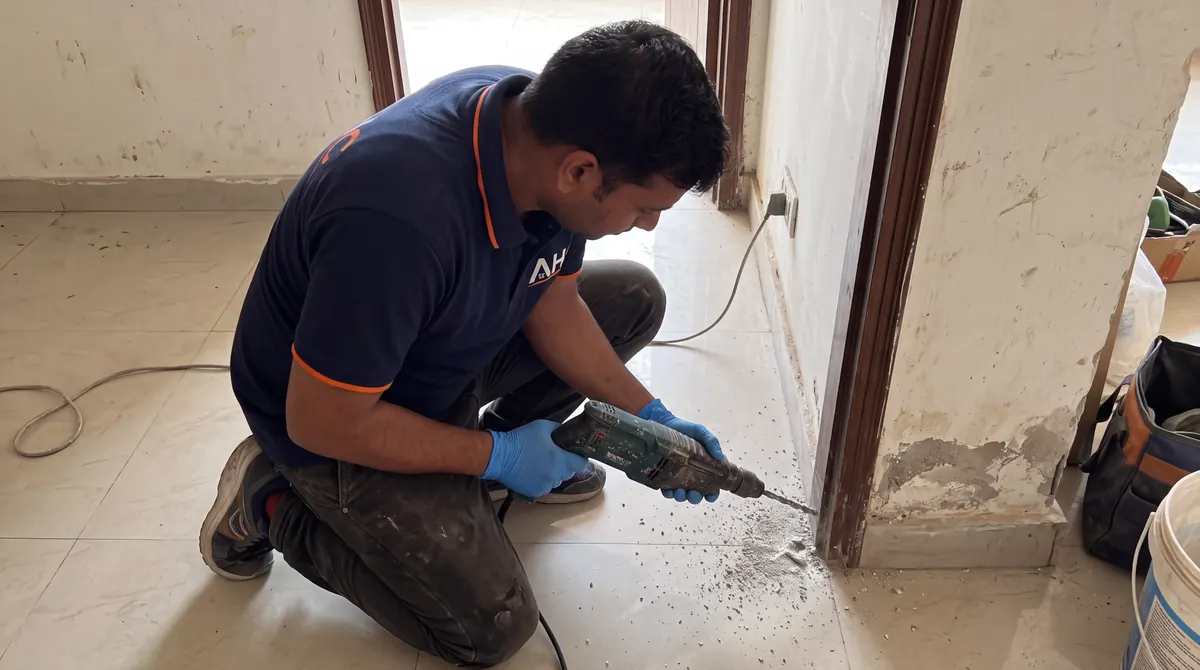
- Treatment fits before painting. Drill-fill-seal treatment leaves small sealed holes in the woodwork and some walls. Done before the painters, they get covered in the same job.
- It's your record. If you find damage now, it's the previous owner's or builder's problem to answer for. Found after a year, it's harder to say when it started.
Step 1: Paperwork to ask for
Ask before or at possession. Not every home will have these, but each one you get tells you something.
- [ ] Pre-construction anti-termite treatment record (for a new flat or a newly built builder floor): who did the soil treatment, when, and whether a warranty was given. This is the soil treatment done before the floor slab is laid, covered in the Bureau of Indian Standards' code IS 6313 Part 2.
- [ ] Any past termite treatment job card for a resale home: date, what was treated, and whether the warranty is still running.
- [ ] History in the building: ask the RWA or a neighbour on the same floor whether termites have been treated in the tower or the lane.
- [ ] Recent repairs: a newly replaced door frame or fresh paint on just one wall can be a repair to termite damage. Ask why it was done.
Step 2: The walk-through checklist
Take a phone torch, a screwdriver with a plastic handle, and an hour. Go room by room. BIS's code for treating existing buildings, IS 6313 Part 3, starts inspections where the building meets the soil (ground floors, steps, columns) and in damp areas such as bathrooms and spots near leaking pipes, and includes wooden panelling, false ceilings, wiring battens, conduits and switchboards in the places to check.
Door and window frames (chaukhat) - [ ] Tap every door frame from the floor up to about 60 cm with the screwdriver handle. Solid wood gives a sharp knock; eaten wood sounds dull or hollow. - [ ] Press the base of each frame with your thumbnail. Wood that dents or crumbles is a warning. - [ ] Look at the floor-frame joint for fine soil or a thin mud line.
Walls, skirting and switchboards - [ ] Run the torch along every wall-floor joint. Look for pencil-thin mud lines, especially in corners. - [ ] Open a few switchboards with the power off, and look inside and around the conduit pipes. - [ ] Check walls that back onto bathrooms or the kitchen, and any wall with damp patches.
Wardrobes, cabinets and lofts - [ ] Open every built-in wardrobe. Check the bottom panel and the back corners where the wood meets the floor and wall. - [ ] Open the kitchen base cabinets, especially under the sink, where it's damp. - [ ] Shine the torch into the lofts and above the false ceiling if there's an access panel.
Ground floor, kothi, builder floor or villa: extra checks - [ ] Wooden steps, staircase railings and the base of the main door. - [ ] The garden side and lawn edges: wood, old tree stumps or stacked timber against the walls. - [ ] Cracks in the plinth or floor along the outer wall.
UC IPM's termite guide calls mud tubes "the most commonly seen evidence" of subterranean termites and notes that damaged wood is often thin at the surface and easily punctured with a screwdriver. Both are things you can check yourself in an empty home. Our post on the signs of termites in Delhi homes has more detail, and if it's furniture rather than walls, see termites or wood borer.
What your findings mean
| What you find | What it likely means | What to do |
|---|---|---|
| Pencil-thin mud lines on walls, skirting or inside switchboards | Active or recent subterranean termites | Book an inspection before any carpentry or painting |
| Hollow-sounding or crumbling base of a door frame | Termites have eaten the frame from inside | Inspection and treatment; the frame may also need repair |
| Small piles of discarded wings near a window or light | A swarm, usually after the April–June storms | Check the room carefully; a swarm nearby doesn't always mean the home is infested |
| Fine powder and small round holes in loose furniture | More likely wood borer (ghun), not termites | A separate treatment |
| Fresh paint on one wall or a new frame in an old home | Possibly a repaired termite problem | Ask the seller and check that area closely |
| Nothing on a high floor in a new tower | Low risk | No treatment needed now; recheck every April–June |
Swipe to see the whole table
Step 3: Get the inspection and decide on treatment
If you find any of the first three signs, or if the home is a ground floor, kothi, villa or builder floor on soil, book a professional inspection before the shift. Our inspection is free. The technician checks the same places you did, maps the affected spots, and recommends a plan.
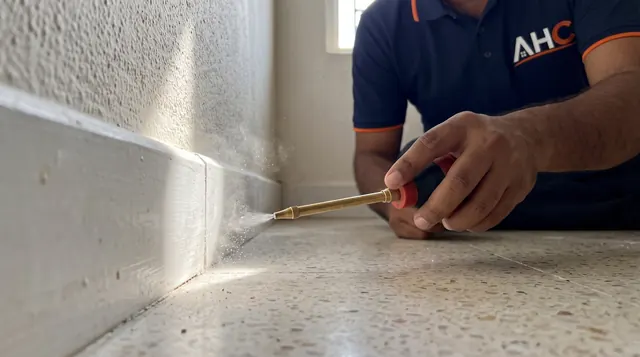
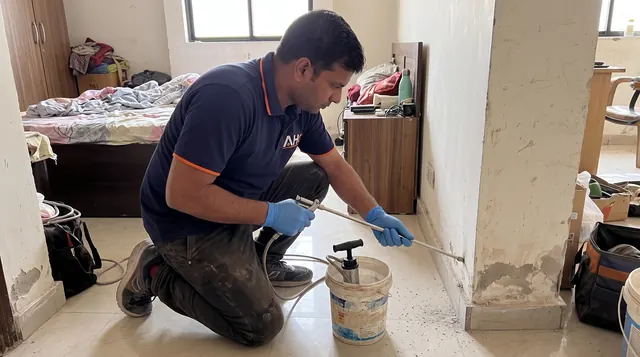
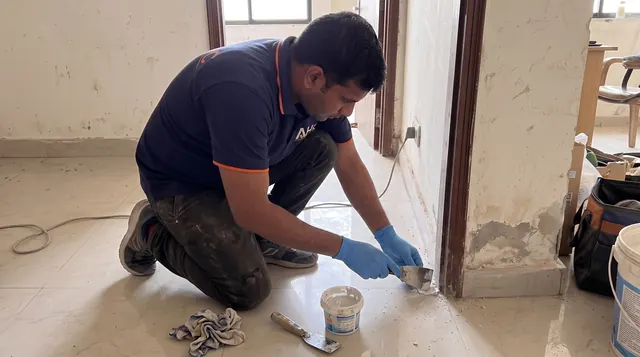
Our termite treatment is drill-fill-seal. Both plans treat the complete woodwork: door frames, windows, wardrobes and cabinets are drilled, injected and sealed, with wall holes at the affected spots. Holes are 6–12 mm. The treatment takes 2–5 hours* on the day.
| Standard | Premium | |
|---|---|---|
| What it covers | Complete woodwork drilled, injected and sealed, plus wall holes at affected spots; no skirting drilling | Standard plus a skirting-level chemical barrier along the wall-floor joint of the whole floor |
| Written warranty | 1 year* | 2 years* |
| 2BHK price, inclusive of all taxes | ₹5,399 | ₹8,999 |
| Best for | Upper-floor flats with signs in a few spots | Ground floors, kothis, villas, builder floors and homes on soil |
Swipe to see the whole table
For a 3BHK, Standard is ₹6,499 and Premium ₹10,799. If you're still building, pre-construction anti-termite treatment of the soil before the slab is a separate service with a warranty of up to 10 years*. For how drilling compares with pipe-based reticulation, see our drill-fill-seal vs reticulation guide.
Step 4: Plan the order of work
Termite work slots in best at the start of the move-in list. A sequence that works in most homes:
- Day 1–3 after possession: your own walk-through and the free inspection.
- Next available slot: termite treatment, if needed. Keep the home empty and the windows open for airing afterwards.
- After treatment: carpentry and modular kitchen fitting. Ask the carpenter to keep a small gap between new wardrobes and walls that showed signs.
- Then painting, which covers the sealed holes.
- A day or two before the truck arrives: if the walk-through showed cockroach droppings or egg cases in the kitchen or bathrooms, this is the easiest time for cockroach control, while the kitchen cabinets are still empty and the gel can go into every hinge and corner.
What a termite check can't tell you
A visual inspection finds termites where they show. It can't see inside a sealed wall or under a tiled floor. That's why a home with no signs today still deserves a look every April–June, when swarms come out after the first storms. And it's why our technicians, in more than a decade of Delhi NCR homes since 2011, ask about the floor and the soil before anything else: a ground-floor kothi with a garden and an eighth-floor flat in a new tower are very different risks.
Sources
- IS 6313 (Part 3):2001 Code of Practice for Anti-Termite Measures in Buildings: Treatment for Existing Buildings, Bureau of Indian Standards
- IS 6313 (Part 2):2001 Anti-Termite Measures in Buildings: Pre-constructional Chemical Treatment Measures, Bureau of Indian Standards
- Subterranean and Other Termites, UC Statewide IPM Program
Need this done?