A sheesham bed from the parents' house, a 20-year-old almirah, the mandir, the chaukhat of the kitchen door: most Delhi homes have wood worth saving. When something starts eating it, the first question is which pest, because termites and wood borer need different treatments at different prices. Spraying the wrong one wastes money and, with termites, can make the problem harder to find.
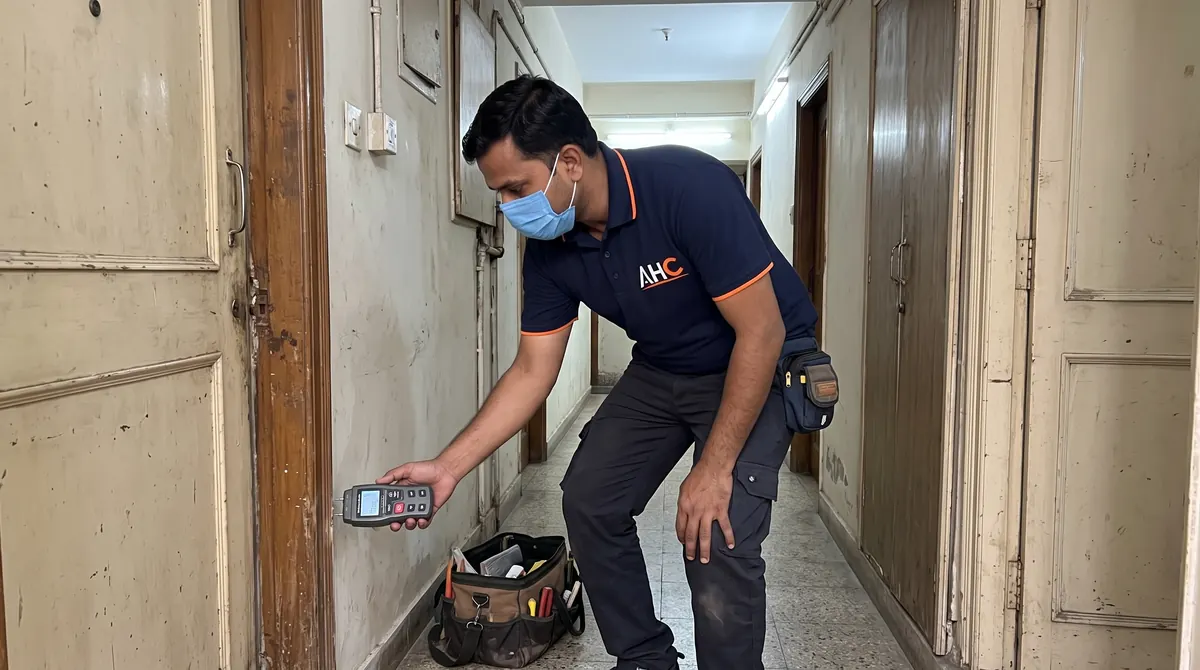
You can tell them apart yourself in about 15 minutes with a screwdriver, a ballpoint pen and your phone camera. Here is how.
Two pests, two different sets of signs
| Termites: deemak (दीमक) | Wood borer: ghun (घुन) | |
|---|---|---|
| Where they come from | The soil, up through floor joints, wall cracks and gaps around pipes | Inside the wood itself; adult beetles lay eggs in the pores of bare wood |
| What you see | Mud tubes about the width of a pencil; soil-like lines inside wardrobes or behind books | Neat round pinholes, about 1 to 3 mm across, often in clusters |
| The dust | Soil and mud in the galleries, not powder | Fine powder in small heaps under the holes |
| The sound when tapped | Dull and papery, because termites eat the wood from inside and leave a thin outer layer | Usually still solid, unless the infestation is old and heavy |
| How it spreads | Along walls and floors to any wood that touches them | To other bare, unpolished wood nearby, when adult beetles emerge |
| Treatment | Woodwork drilled, injected and sealed, plus the walls where active; Premium adds a skirting barrier | Injection into the holes plus surface treatment of the piece |
Swipe to see the whole table
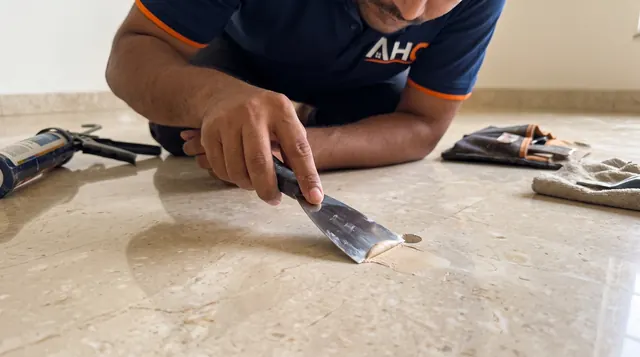
Test 1: the tap test
Use the handle of a screwdriver, not the tip. Tap every 10–15 cm along the places termites reach first:
- The bottom 30 cm of every chaukhat, where it meets the floor
- Skirting boards and wooden wall panels
- The back panel and base of almirahs and wardrobes that stand against a wall
- Bed legs, and the mandir's base if it sits on the floor
Solid wood gives a sharp knock. Wood that termites have eaten from inside sounds dull and papery, and the surface may dent under a firm tap. Mark each dull spot with a pencil. Wood borer rarely changes the sound until the damage is old, so a piece full of pinholes that still knocks solid is pointing towards ghun.
Test 2: the screwdriver test
Pick one dull spot, ideally on a hidden edge such as the inside face of a chaukhat or the back of an almirah. Press the tip of a flat screwdriver in with steady thumb pressure. Don't lever or dig.
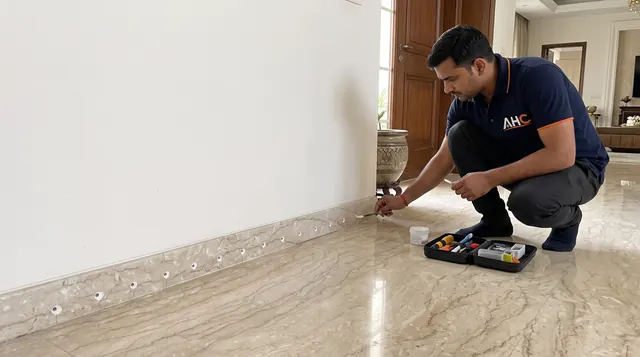
- The tip sinks in easily and you see layered galleries packed with soil or mud: termites.
- The tip meets solid wood, but fine powder trickles out of round tunnels nearby: wood borer.
- The wood is soft, dark and damp, with no soil and no powder: likely rot from seepage. Fix the leak first, and still get it inspected, because damp wood draws termites.
Stop at one or two probes. The goal is to identify the pest, not to open up the frame; the inspection needs to see the damage as it is.
The ballpoint pen check for pinholes
The University of California's 2010 Pest Notes on wood-boring beetles describe using a ballpoint pen as a gauge for exit holes. The Maine Department of Agriculture's fact sheet puts it simply: the tip of a click-type ballpoint pen fits only through the smallest holes, made by the true powderpost beetles. Larger holes point to other borer families. For you, the useful part is this: round, clean-edged holes the size of a pen tip are the signature of ghun, not deemak. Termites don't make exit holes like that.
Rub the powder between your fingers
North Carolina State University's extension guidance describes the powder (called frass) of true powderpost beetles as feeling like talcum powder, and that of furniture beetles as powdery but gritty. Subterranean termites leave soil, not powder. If your "powder" is gritty mud that crumbles into lumps, think termites.
Is it still active?
Old damage and active damage look alike at first. Check these before anyone quotes for treatment.
For wood borer:
- The Maine fact sheet notes that active infestations usually have powder the colour of fresh-cut wood sifting from the holes. NC State's guidance says powder that is yellow and caked is usually old.
- Fresh holes have sharp, clean edges; old holes look weathered like the wood around them.
- Vacuum the powder, lay a sheet of dark paper under the piece and look again after a week or two. New powder means active borer. No powder doesn't prove it's over, because larvae can sit deep in the wood for months.
For termites:
- Photograph a mud tube, then break a 2–3 cm section. If it's rebuilt within a few days, termites are active.
- Look for small piles of identical wings near windows and lights after rain.
What to photograph before you call
Clear photos let the technician come with the right equipment and often answer the question before the visit. Send these on WhatsApp to 97111 11086:
- A wide shot of the whole piece or doorway, so we can see what it is and where it stands
- A close-up of the holes with a one-rupee coin beside them for scale
- The powder heap before you clean it up
- Any mud tube, before you break it
- The joint where the chaukhat meets the floor
- The inside back panel and base of the almirah
- Any damp patch, seepage line or leaking pipe within a metre of the damage
- The floor directly under the piece
Take them in daylight or with the phone torch on, from about 30 cm away for close-ups.
What termite treatment involves
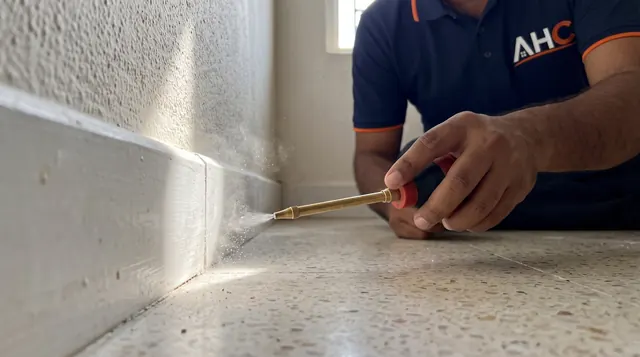
Termites come from the soil, so treating one piece of furniture alone doesn't stop them. On Standard, the complete woodwork (every chaukhat/door frame, window frame, wardrobe, cabinet and almirah back) is drilled with 6–12 mm holes, injected with termiticide and sealed, plus wall holes at the spots where mud tubes or activity are found. Premium adds the drill-fill-seal skirting barrier: holes at about 45°, roughly every 12 inches along the wall–floor junction across the complete floor, on one side of each wall, termiticide pumped in until each hole takes no more, and every hole sealed with white cement or a filler matched to the floor. Ground-floor homes, kothis and villas should take Premium. The technician picks imidacloprid 30.5% SC, fipronil 2.92% EC, bifenthrin 2.5% EC or chlorpyrifos 20% EC after the inspection, CIB&RC-registered and used as per the label. The work takes 2–5 hours* on the day.
| Home size | Standard (1-year warranty*) | Premium (2-year warranty*) |
|---|---|---|
| 1BHK | ₹4,549 | ₹7,549 |
| 2BHK | ₹5,399 | ₹8,999 |
| 3BHK | ₹6,499 | ₹10,799 |
| 4BHK | ₹7,549 | ₹12,599 |
Swipe to see the whole table
All prices inclusive of all taxes. 5BHK+, villas and kothis are priced after a free inspection. Both plans include an audit visit at month 3, and Premium adds one at month 12. If termites are confined to one kitchen or bathroom, spot treatment starts at ₹1,449.
What wood borer treatment involves
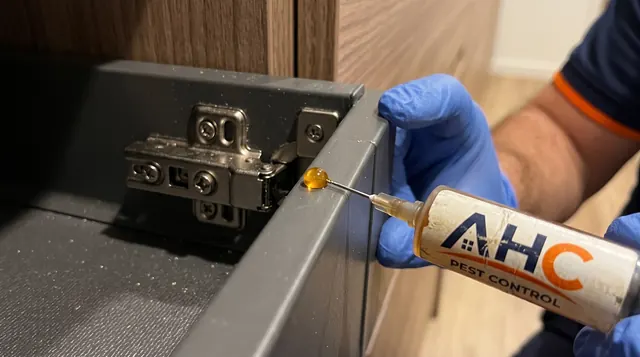
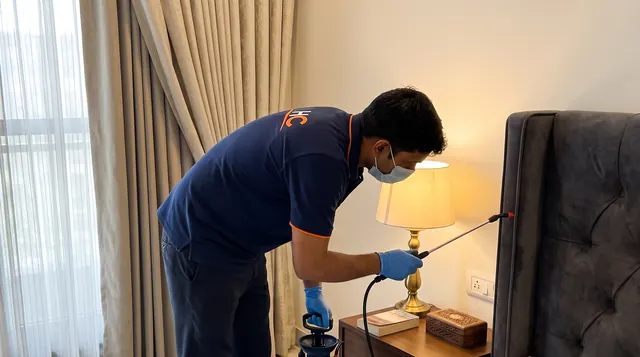
Wood borer lives inside the piece, so the treatment goes into the piece. After a free inspection, the technician tells you which pieces are active and which are worth treating. The treatment is injected into the exit holes and the channels behind them, and the bare, unpolished wood around them is treated so new eggs aren't laid there.
Wood borer treatment starts at ₹1,799 inclusive of all taxes for one furniture set or one set of door frames. More pieces, or a whole house of frames, are quoted in writing after the inspection.
Set your expectations on two points. Old holes don't close, so success means no fresh powder and no new holes over the following months. And larvae can live inside the wood for a long time: NC State's guidance puts the typical life cycle of the true powderpost beetles at 9 to 12 months, and furniture beetles often take 2 years or more. A larva deep in the wood can still come out later.
Mistakes that make both worse
- Spraying kerosene or a shop spray on mud tubes. The termites move to a new route and become harder to trace.
- Moving an infested almirah into another room. You carry the problem with it.
- Polishing or filling borer holes before the inspection. We need to see which holes are fresh.
- Throwing out a solid-wood piece before anyone has checked it. Many can be treated.
- Bringing second-hand wooden furniture home without checking it for pinholes and powder first.
Read more: Wood borer treatment in Delhi · in Gurugram · in Noida · in Ghaziabad · in Faridabad · Termite control in Delhi · Termite control in Gurugram · 4 signs of termites in Delhi homes
Need this done?