
The rain stopped weeks ago, the cooler has been switched off, and the evenings feel cooler. It's natural to think the mosquito season is over. In Delhi it usually isn't. The Municipal Corporation's figures, reported in the first week of October, showed 286 dengue cases in September, the highest month of 2026 so far, and 98 more in the first week of October alone (The Hans India, MCD report).
Dengue mosquitoes don't need rain. They need a few spoons of still, clean water and warm days, and a Delhi NCR home in late October has plenty of both. What follows is why the risk lasts, where the water hides at this time of year, and a 10-minute route through your flat or kothi that you can repeat every Sunday until the nights turn properly cold.
Why dengue peaks after the monsoon, not during it
Dengue in Delhi peaks after the monsoon, and NCVBDC notes that breeding sites increase during the monsoon and post-monsoon period (NCVBDC). It takes weeks for the monsoon's water to turn into a large mosquito population, and more weeks for the virus to build up in it. Three things line up in October:
- Water is still lying around. Coolers that were switched off but never drained, pot trays, roof junk and tarpaulin folds still hold the last of the rain, plus whatever we add while washing balconies and cleaning for Diwali.
- Days are still warm. The WHO notes that the virus needs about 8 to 12 days inside a mosquito at 25 to 28°C before that mosquito can pass it on. Delhi afternoons stay in that range through most of October.
- There are more infected people to bite. Each case in a colony is a fresh source for the mosquitoes nearby, so cases build on each other until the cold breaks the cycle.
The MCD reported that its breeding checkers had found mosquito breeding in more than 1.89 lakh households in 2026 by early October. On our visits, our technicians find it most often in homes where the family is sure there is "no standing water anywhere".
Why a weekly check, and why 10 minutes is enough
A weekly check works because the Aedes life cycle is just over a week. The US CDC puts egg to adult at 7 to 10 days. If you empty and scrub every container once every 7 days, the larvae in it never get to fly.
Two details make the difference between a check that works and one that only looks like it:
- Scrub, don't just tip out. The CDC notes that Aedes females lay their eggs on the inside walls of containers, just above the waterline, and that the eggs can survive drying out for up to 8 months. Tipping the water out leaves them stuck to the wall, ready to hatch at the next refill. A 10-second scrub with an old brush removes them.
- Same day, every week. Sunday morning works for most families. A missed week is an adult batch.
What you're looking for
Larvae, called wrigglers, are a few millimetres long and jerk up and down in the water. Pupae are comma-shaped and float near the surface. Shine a phone torch into the water from the side; both show up clearly. If you see either, empty the container on dry ground or into a drain, scrub it, and dry it.
| What you see | What it means | What to do |
|---|---|---|
| Wrigglers in a pot tray or bowl | Adults in a few days | Empty, scrub, dry today |
| Comma-shaped pupae | Adults in 1–2 days | Empty now, then check the next container nearby |
| Black-and-white mosquitoes biting by day | Breeding within a few houses | Do the full check, cover yourself, tell your RWA |
| Larvae in the roof tank | Lid gap or missing cover | Fix the lid, mesh the overflow pipe, tell whoever manages the tank |
Swipe to see the whole table
The 10-minute weekly checklist
Take a torch, an old toothbrush and a dry cloth, and go in this order so you don't skip a room.
Minutes 0–2: balcony and terrace - [ ] Pot trays emptied and wiped, or filled with sand to the rim - [ ] The switched-off cooler drained fully, the pads removed, the tank wiped dry and the cooler covered - [ ] Buckets and mugs turned upside down - [ ] Tarpaulin and plastic covers shaken out, no folds holding water - [ ] Bird bowl and pet water bowl emptied and refilled
Minutes 2–4: roof, if you have access - [ ] Water tank lid closed and tight, overflow pipe covered with a mesh - [ ] Old tyres, broken pots, thermocol boxes and paint tins removed or turned over - [ ] Roof drain outlet clear, no pool around it
Minutes 4–6: kitchen - [ ] The tray under the fridge (behind the bottom grille) checked and wiped; it collects defrost water most people never see - [ ] Water-filter waste outlet and any storage drums covered - [ ] Sink trap and floor drain covered or flushed
Minutes 6–8: bathrooms and utility - [ ] Spare buckets of stored water covered or emptied - [ ] Washing machine outlet area dry - [ ] Floor traps flushed with hot water
Minutes 8–10: inside the rooms - [ ] Money plant bottles and flower vases: water changed and the inside wiped - [ ] Urli bowls with floating flowers emptied every 2–3 days during the festival - [ ] AC drip tray and outlet pipe, where it ends in a pot or bucket
If you live in a flat, the roof is the society's. Ask your RWA to check that every overhead tank lid closes tightly and that the overflow pipes have a mesh, because one open tank can breed mosquitoes for the whole block.
The October extras: coolers, Diwali flowers and the cleaning itself
The live dengue checklist on our blog covers the seven usual breeding spots. October adds three of its own:
- The cooler put away wet. Families switch the desert cooler off in late September and leave it on the balcony with a few centimetres of water at the bottom. It becomes the best breeding pot in the house. Drain it, dry the tank in the sun for a day and cover it before it goes into storage.
- Festival water. Urli bowls, the kalash, rangoli bowls with flowers and diyas left out with oil and water. Change it every two or three days.
- Diwali cleaning. Washed balconies, rinsed buckets and pots left to "dry" in a corner hold water for days. Turn everything upside down when you finish.
Bites, fever and when to see a doctor
Dengue mosquitoes bite in the daytime, which the WHO highlights (WHO), so the hours children spend at home after school matter as much as the night. Full sleeves, a repellent for the skin, and window mesh help. Vaporisers help indoors with the room ventilated; avoid burning coils in a closed room, since one coil's smoke can carry as much fine particulate as 75–137 cigarettes (Environmental Health Perspectives).
This is general information, not medical advice. See a doctor for any high fever during dengue season rather than treating it at home, and don't self-medicate: the WHO says there is no specific treatment, that paracetamol is used for pain, and that anti-inflammatory painkillers such as ibuprofen and aspirin should be avoided because they can increase the risk of bleeding (WHO). The WHO lists warning signs of severe dengue that often appear just as the fever comes down: severe stomach pain, repeated vomiting, fast breathing, bleeding from the gums or nose, blood in vomit or stool, restlessness, and pale, cold skin (WHO). If any of these appear, go to a hospital the same day. Children, older people and pregnant women need extra care; our page for parents explains how we treat homes with small children.
When your own check isn't enough, and what AHC's treatment covers
The weekly check deals with what is inside your home. It can't do much about a neighbour's terrace, a construction site behind the colony, or adult mosquitoes already resting behind your curtains and under the beds. If you are still being bitten during the day after two weekly checks, or someone at home has had dengue this season, a treatment is worth it.
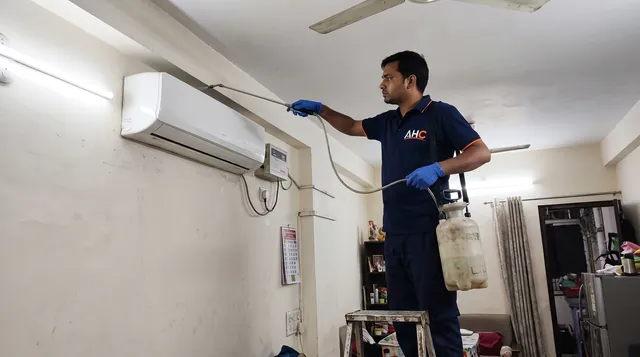
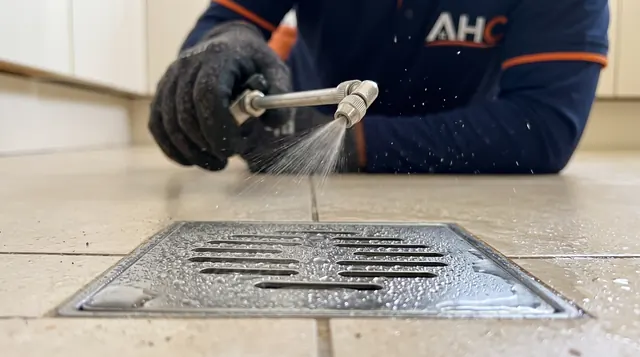
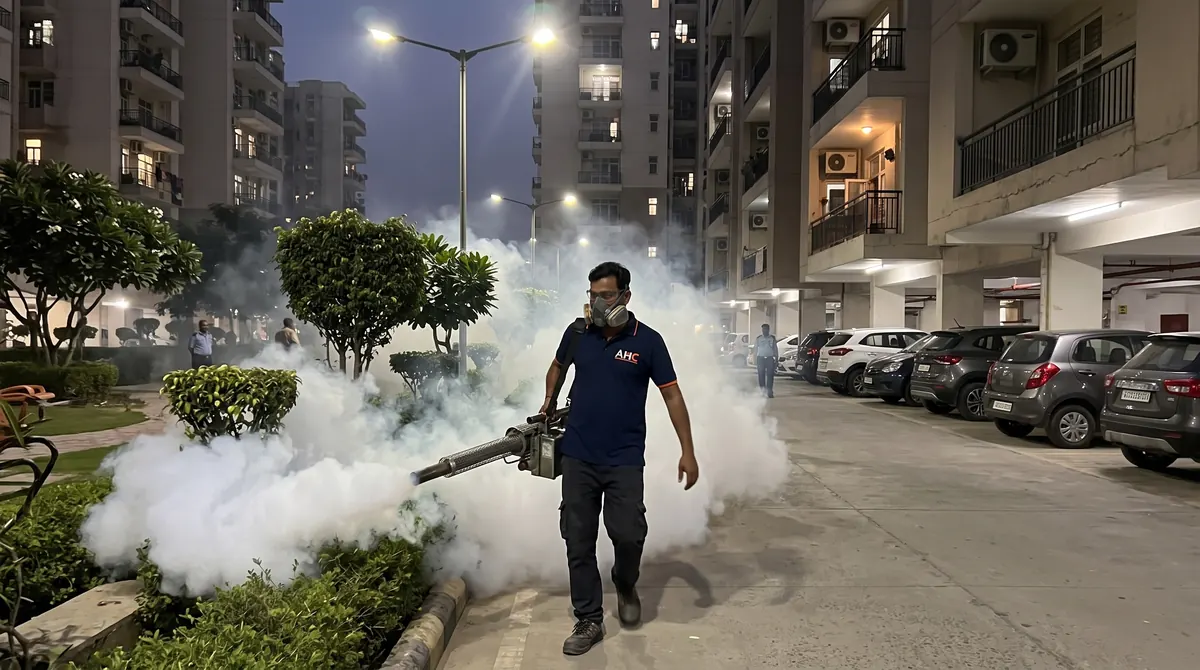
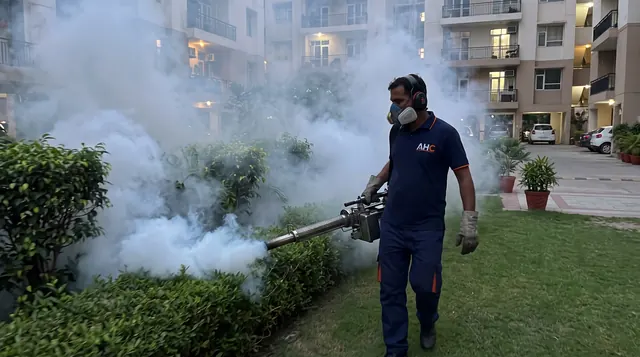
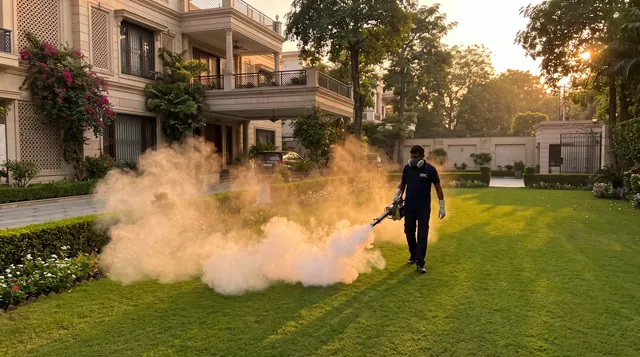
Our mosquito control visit takes about 45 to 60 minutes. The technician does the same breeding check with you, applies a larvicide to water that can't be emptied (never in drinking water), and sprays the dark resting spots indoors. Cold fogging (ULV) for balconies and lawns is a separate option on our fogging services page.
| Service | 1RK | 2BHK | 3BHK |
|---|---|---|---|
| Mosquito control, inclusive of all taxes | ₹1,449 | ₹1,899 | ₹2,299 |
| Cold fogging (ULV), inclusive of all taxes | ₹1,199 | ₹1,199 | ₹1,699 |
Swipe to see the whole table
Mosquito treatment is an on-the-spot reduction, so it has no warranty. Mosquitoes fly in from a few houses away, which is why the weekly check is still your job afterwards, and why it works best when the whole lane does it on the same Sunday.
Sources
- Delhi records 98 dengue cases in first week of October, tally reaches 695, ThePrint (PTI)
- Dengue and severe dengue, World Health Organization
- Life cycle of Aedes mosquitoes, US Centers for Disease Control and Prevention
- Delhi: 98 dengue cases in 1st week of Oct, tally touches 695 (MCD report), The Hans India, 7 Oct 2026
- Guidelines for Prevention and Control of Dengue in Schools (2019), NCVBDC, MoHFW
- Mosquito coil emissions and health implications, Environmental Health Perspectives (2003)
Need this done?