
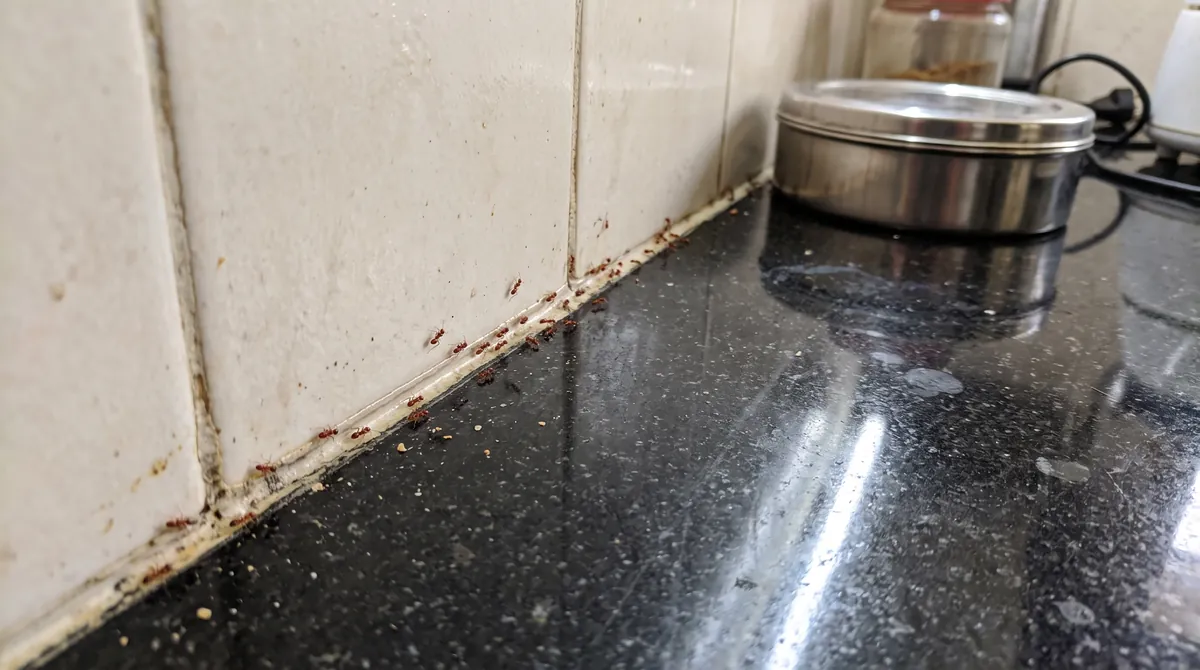
It happens every Diwali in Delhi NCR homes. The rangoli is finished at the door, the puja thali is ready with batashe, ladoo and a diya of ghee, and by morning there's a thin, moving line of ants from the skirting to the prasad. Families who would happily spray a cockroach don't want to spray the mandir, and they're right not to.
You don't need to. Ants in the puja room are almost always foragers following a trail to food, and both the trail and the food can be dealt with without any spray. Here is how, step by step, and what to do if they keep coming.
Why ants find the rangoli and the puja room first
Ants go where there's sugar, fat and starch, and in Diwali week the puja room has all three: mithai and batashe, ghee from the diyas, and rice flour in the rangoli. They don't find it by chance. The first worker to find food lays a scent trail back to the nest, and the rest follow it. The University of California's IPM guide on ants notes that wiping the trail with soapy water removes the scent that guides the others.
The nest itself is usually somewhere else: inside a wall void, under the skirting, behind a kitchen cabinet or in a balcony planter. What you see on the thali are workers, and they're a small part of the colony.
Which ants are on your prasad?
The type of ant changes how stubborn the problem is, so take a close look, or a photo, before you start.
| What you see | Likely type | What it's after | How hard to control |
|---|---|---|---|
| Tiny, pale yellow-brown ants, hard to see one by one | Pharaoh-type ants | Sweets, oil, fat; nests inside walls and furniture | Hard; needs bait, never spray |
| Small black ants in a clear line | Common house ants | Sugar, prasad, honey | Moderate; trail cleaning and sealing help a lot |
| Larger reddish ants that bite | Red ants (laal cheenti) | Meat, insects, sweets; often from outside | Moderate; seal entry, check planters |
| Big black ants near wood | Carpenter-type ants | Moisture and soft wood | Check the woodwork; may need treatment |
Swipe to see the whole table
Step by step: getting ants off the puja room without spraying
Do this the evening you first see them. It takes about 45 minutes in all.
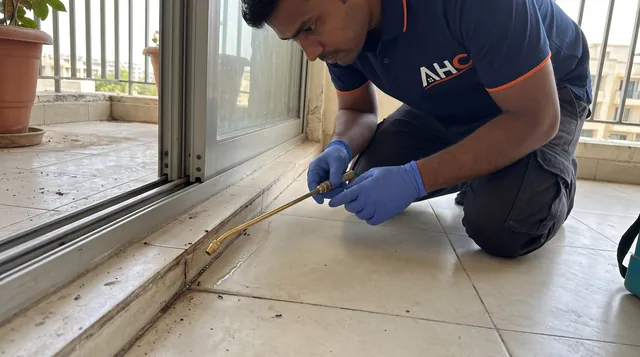
- Follow the trail to where it starts (10 minutes). Watch where the line comes from: a gap in the skirting, the joint of the wooden mandir, a switchboard, a crack in the floor. That's the spot to seal later. Texas A&M AgriLife's guide to household ants also recommends following foraging trails to find the nest.
- Lift the food off the trail (5 minutes). Move the prasad, sweets and fruit to a sealed steel dabba or the fridge for the night.
- Wipe the whole trail with soapy water (10 minutes). A few drops of dish soap in a mug of water and a cloth. Wipe the full length, from the gap to the thali, not just the end. Without the scent, the next ants wander instead of marching.
- Clean the ghee and oil (10 minutes). Wipe drips around diyas with hot soapy water. From now on, put diyas on a steel plate or tray, never straight on the floor or the mandir shelf.
- Seal the entry gap (10 minutes). For tonight, a smear of petroleum jelly over a small gap works; UC IPM suggests it as an emergency plug. For good, fill skirting gaps with white cement or a silicone sealant once Diwali is over.
Protecting the prasad and bhog during the festival
- The water moat. Stand the prasad bowl or thali in a wider plate with 1 to 2 cm of water. Ants can't cross it. Change the water daily so it doesn't become a mosquito pot.
- Cover everything that isn't being offered right now. Steel dabbas with tight lids, or glass jars. Plastic boxes with loose lids don't stop pharaoh-type ants.
- Offer, then clear. After the aarti, move the bhog to the kitchen and wipe the shelf. Batashe and mishri left overnight are an invitation.
Rangoli that doesn't feed the ants
Rice-flour rangoli is beautiful and traditional, but it's food. In a Delhi flat, a rice-flour rangoli at the door brings ants to the threshold, and from there inside.
- Use stone-powder rangoli colours for the main design. They're mineral, not food.
- If you use rice flour, keep it outside the door, not inside, and sweep it up after the festival rather than leaving it for days.
- Flower rangoli: marigold and rose petals are fine, but clear them after a day or two, before they start to rot.
- On marble or Kota stone, lay the rangoli on a thin base of chalk powder, so the colours don't stain the floor.
Why spraying makes ant problems worse
A spray kills the ants you can see and leaves the colony untouched. UC IPM's guide says spraying ants indoors "will not prevent more ants from entering", and that sprays kill foragers, not the queens. Texas A&M's guide goes further: insecticide sprayed on ant trails kills only a few workers and can make a colony split into separate colonies. Pharaoh-type ants are known for this; they multiply by "budding", where part of the colony moves to a new nest.
So a spray on the mandir can turn one nest behind the skirting into two, one of them inside your wooden mandir. And you'd be spraying near the prasad, the idols and the place where the family sits for the puja.
Home remedies: what helps and what doesn't
| Remedy | Does it help? | Why |
|---|---|---|
| Wiping the trail with soapy water | Yes | Removes the scent trail |
| Water moat under the prasad | Yes | Ants can't cross water |
| Sealed steel or glass containers | Yes | Takes away the food |
| Petroleum jelly in small gaps | Short term | Blocks an entry point for a few days |
| Haldi, cinnamon or pepper lines | A little, briefly | Ants may detour, but the colony is untouched |
| Insecticide chalk | Not near the mandir | It's an insecticide; children touch it and it smears |
| Vinegar or lemon wipe | Removes the trail, but | It etches marble and Kota stone floors and shelves |
| Shop aerosol spray | No | Kills a few, can split the colony |
Swipe to see the whole table
When to call a professional, and what AHC's ant control includes
If ants keep coming back a week after you've cleaned trails and sealed food, the colony is close and well fed, and it needs bait. Baits work because workers carry them back to the nest and share them, which a spray can't do. UC IPM puts it at 5 to 10 days to see fewer ants with bait stations, and Texas A&M notes that some pharaoh ant colonies take 3 to 4 weeks or longer.
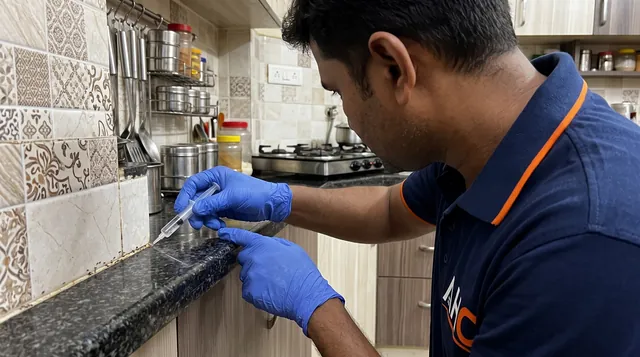
On an ant control visit, the technician follows the trails, places gel bait along them and at the entry gaps, and treats the nest where it can be found, in about 30 to 45 minutes. Bait goes into cracks and joints, away from the idols and the prasad shelf, and we don't spray the mandir.
| Home size | Ant control, inclusive of all taxes | Herbal option, inclusive of all taxes |
|---|---|---|
| 1RK | ₹899 | ₹1,299 |
| 2BHK | ₹1,149 | ₹1,749 |
| 3BHK | ₹1,349 | ₹2,149 |
Swipe to see the whole table
If ants are still active 2 to 4 weeks after the treatment, we come back for a free revisit*. Families who'd rather avoid conventional products near the puja room choose herbal pest control. If cockroaches are also around the kitchen, general pest control covers both in one visit. With a baby, a pregnancy or pets at home, read our guide to pest control safety first.
Sources
Need this done?